
A switch BL (switch bill of lading) is a replacement bill of lading issued for the same shipment. It is commonly used in three-party trade, where a trading company purchases goods from one supplier and resells them to an overseas buyer.
For traders sourcing products from China, this arrangement can help protect supplier relationships and reflect the resale transaction. However, carriers and other B/L issuers restrict which details traders can change.
Table of Contents:
How does a switch bill of lading work?
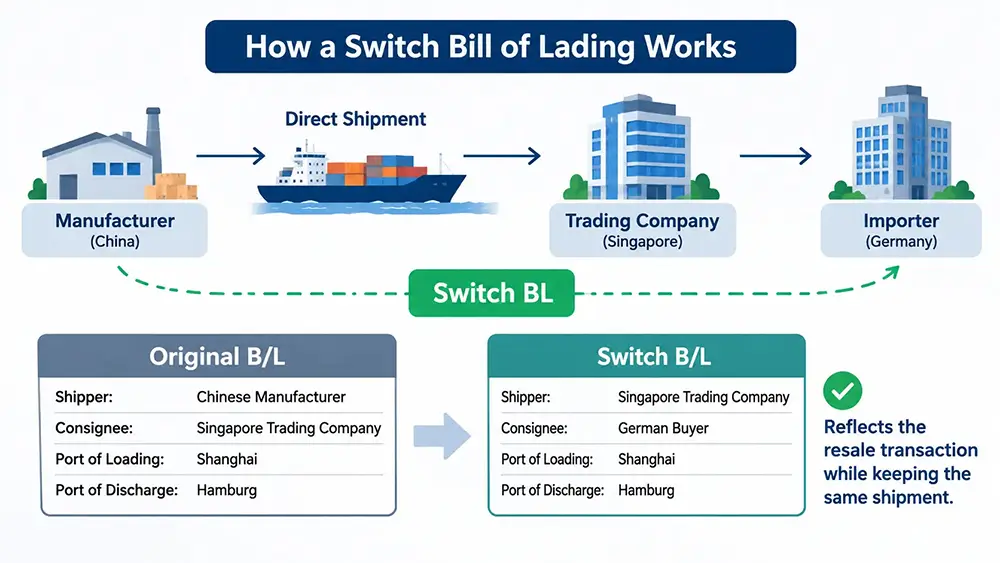
Imagine a Singapore trading company buying goods from a Chinese manufacturer and reselling them to a customer in Germany. Instead of routing the cargo through Singapore, the trader arranges for direct shipping from China to Germany.
Here is how the two bills of lading might differ:
| B/L details | Original B/L | Switch B/L |
|---|---|---|
| Shipper | Chinese manufacturer | Singapore trading company |
| Consignee | Singapore trading company | German buyer |
| Port of loading | Shanghai | Shanghai |
| Port of discharge | Hamburg | Hamburg |
While the commercial parties change, the physical movement of the goods remains the same.
Only an authorized B/L issuer can approve the switch and issue a replacement after cancelling the original set. Whether a trader needs this arrangement depends on the transaction and agreed shipping terms.
What information can you change on a switch BL?
Traders often request changes to shipper and consignee details. However, the revised document must accurately reflect the cargo and its journey.
| B/L information | Permitted changes |
|---|---|
| Shipper | Subject to issuer approval |
| Consignee | Subject to issuer approval |
| Notify party | Subject to issuer approval |
| Freight terms | Subject to agreement and issuer approval |
| Cargo description | Accurate revisions with issuer approval |
| Actual shipment date | No changes |
| Actual port of loading | No changes |
| Cargo quantity and weight | Must reflect the actual cargo |
| Cargo condition and handling instructions | No misrepresentation or omission of material facts |
When issuing a replacement B/L, the issuer must clearly distinguish between the actual shipment date and the date and place of issuance of the new document.
Switching a B/L does not change a product’s country of origin. Traders must also disclose any information that customs authorities legally require.
Switch bill of lading requirements
Before approving a request, carriers and other authorized issuers typically verify the applicant’s authority and assess the proposed changes.
Depending on their policies, applicants may need to provide:
- A written request explaining the reason for switching
- A full set of original bills of lading, with endorsements where necessary
- Revised shipping instructions
- Authorization from relevant parties
- A letter of indemnity (LOI)
- Payment of applicable documentation fees
Transactions involving a letter of credit may require additional arrangements, particularly if a bank holds the original B/L.
Even with an LOI, the issuer can refuse changes that misrepresent shipment details or violate applicable regulations.
Switch bill of lading procedure
1. Identify the authorized issuer
Determine whether you need to switch a House Bill of Lading (HBL) or a Master Bill of Lading (MBL). A freight forwarder cannot independently replace a carrier-issued MBL without the carrier’s approval.
2. Submit revised shipping instructions
Include the new shipper, consignee, and notify party details where applicable. Supporting documents help the issuer evaluate the request against its policies and regulatory obligations.
3. Surrender the original B/L
For paper bills of lading, return the full original set for cancellation. Allowing two valid sets to circulate for the same cargo creates a risk of competing delivery claims.
4. Review the replacement draft
Compare the revised commercial details with the resale agreement and verify the accuracy of the shipping information. Changes to certain B/L details may also require amendments to cargo manifests or advance customs filings.
5. Obtain the switch B/L
After completing its checks, cancelling the original set, and collecting any applicable fees, the issuer can release the replacement. The buyer must still follow customs and carrier release procedures at destination.
When should you request a switch BL?
Ideally, discuss the need for a switch BL when booking ocean freight from China. Although some carriers accept requests while cargo is in transit, deadlines vary according to the route, documentation status, and destination regulations.
Delaying the request until shortly before arrival may complicate the process, especially if a bank or another trading party still has the original documents.
Costs deserve attention as well. Beyond the switch B/L fee, you may incur courier expenses, manifest amendment charges, or storage costs if paperwork delays cargo collection.
Ask about the applicable cut-off time and charges early enough to factor them into your resale arrangements.
Is a switch BL the same as a telex release?
No. Switching replaces an existing bill of lading. Whereas a telex release allows cargo collection without presenting the surrendered original B/L at destination, subject to the carrier’s release instructions.
Both procedures may apply to the same shipment, but receiving a switch B/L does not automatically authorize cargo release.
Arranging sea freight from China for three-party trade
Direct shipments from Chinese suppliers to overseas buyers require close coordination between freight bookings and trade documentation.
Depending on your sales arrangement, you may also need cargo pickup, export clearance, or delivery at destination. ASLG offers customized logistics solutions to support these requirements.