
When importing goods from China into the United States, you’ll encounter two key customs filings: CBP Form 3461 and CBP Form 7501.
Form 3461 helps importers request cargo release, while Form 7501 provides detailed entry information for duty assessment and customs compliance.
Understanding the difference helps you track customs clearance, review import costs, and identify potential declaration errors.
CBP Form 3461 vs. 7501 at a glance
| CBP Form 3461 | CBP Form 7501 | |
|---|---|---|
| Official name | Entry/Immediate Delivery | Entry Summary |
| Main purpose | Request cargo release | Report detailed entry information |
| Filing stage | Usually before cargo release | At entry or within the applicable filing deadline |
| Key information | Shipment, importer, consignee and entry details | Tariff classification, origin, value, duties and fees |
| Duty assessment | Not its primary purpose | Provides the basis for duty assessment |
| Filing party | Importer or authorized customs broker | Importer or authorized customs broker |
Both forms relate to the same customs entry when the importer uses a separate release and entry summary process.
What is CBP Form 3461?
Officially known as Entry/Immediate Delivery, CBP Form 3461 allows importers or their customs brokers to request cargo release from U.S. Customs and Border Protection (CBP).
Customs officers use this information to review shipment details, identify the importer and consignee, and verify applicable customs bond coverage.
Filing Form 3461 does not guarantee immediate release. CBP may request further information, hold the cargo, or select it for examination.
Before arranging cargo pickup, confirm the actual release status with your customs broker rather than relying solely on a copy of Form 3461.
If your goods fall under FDA regulations, you should also check the FDA entry status separately.
What is CBP Form 7501 used for?
As the official Entry Summary, CBP Form 7501 provides the information CBP needs to assess import duties, collect trade statistics, and evaluate compliance with applicable regulations.
For businesses sourcing goods from China, this document is particularly useful when reviewing import costs. It brings together tariff classifications, declared values, applicable duty rates, taxes, and fees.
For example, an importer purchasing industrial components from Shenzhen can review the entry summary to see which tariff provisions the broker applied and how the declared customs value affects the estimated duties.
Keep a copy for your import records and future cost reconciliation.
When do importers file these forms?
Today, importers and customs brokers handle most commercial customs filings electronically through the Automated Commercial Environment (ACE).
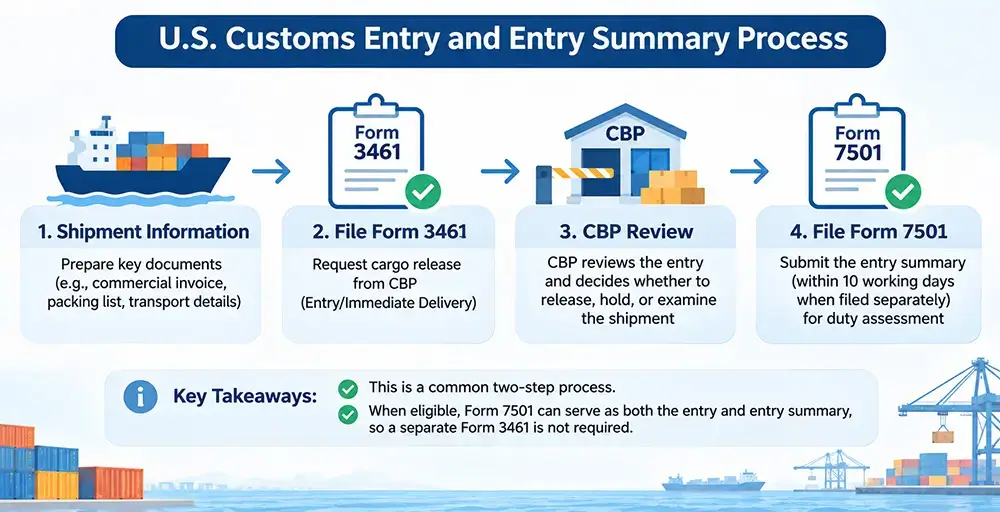
In a typical two-stage process, the importer or broker first submits cargo release information. CBP then reviews the entry and determines whether to release the goods.
For separate entry summary filings, federal regulations generally give importers 10 working days from the time of entry to submit Form 7501 and deposit the applicable estimated duties.
However, not every shipment requires both forms. Under certain procedures, importers can use Form 7501 to satisfy both entry and entry summary requirements without filing a separate Form 3461.
Consult your customs broker to determine which procedure applies to your shipment. For further details, refer to 19 CFR § 142.12.
For U.S. ocean imports, the Importer Security Filing (ISF) follows a separate filing schedule before loading at the foreign port.
What should you check on CBP Form 7501?
Even when a licensed customs broker handles the declaration, the importer of record remains responsible for exercising reasonable care in customs matters.
When reviewing your entry summary, pay particular attention to:
Importer of record: Verify the company name and identification number.
- HTSUS classification: Check whether the tariff codes accurately describe your products.
- Country of origin:Confirm the declared origin rather than assuming it matches the country of dispatch.
- Entered value:Compare the declared customs value with the transaction records and applicable valuation requirements.
- Duties and fees: Review applicable tariff rates, additional duties, and processing fees.
If you notice a discrepancy, contact your broker promptly. Depending on the entry’s status, different correction procedures may apply.
Does Form 7501 prove that you have paid import duties?
Not on its own. Form 7501 shows the amounts that the filer declares for the customs entry, including estimated duties, taxes, and fees.
To verify payment, request the relevant payment confirmation or customs statement records from your broker.
Remember that CBP may subsequently adjust the duty amount during liquidation, when it finalizes the entry’s duty assessment.
How do you get copies of Forms 3461 and 7501?
If a licensed customs broker handles your U.S. import entry, request the relevant cargo release and entry summary records directly from the broker.
You can also find blank forms through the official CBP forms directory. However, a blank form cannot confirm an actual shipment status.
Importers with appropriate ACE access can also retrieve available entry information through their accounts.
Preparing your shipment from China for U.S. customs
Accurate customs declarations start with reliable supplier information. Before dispatch, check your commercial invoices for precise product descriptions, correct quantities, and accurate transaction values.
Sharing these details early with your freight forwarder and customs broker helps prevent documentation gaps across the supply chain.
ASLG arranges international freight from China and works with licensed U.S. customs brokers to support import clearance. By coordinating transportation and customs clearance, we help keep your goods moving from origin to destination.