
A customer recently asked us:
“My cartons are 50 × 60 × 40 cm and weigh 15 kg each. How many cartons can I load into a 40HQ container without wasting too much space?”
The answer depends on more than the total container volume. Internal dimensions can vary slightly between containers and shipping lines, which can affect the final loading quantity.
You also need to consider the carton dimensions, cargo weight, container size, loading pattern, and stacking requirements.
For this shipment, we used the selected 40HQ container specifications to calculate the loading arrangement. The result was 598 cartons.
Below, we explain how we reached this result and what can change the number of cartons that fit in a container.
Container Size, Capacity & Payload
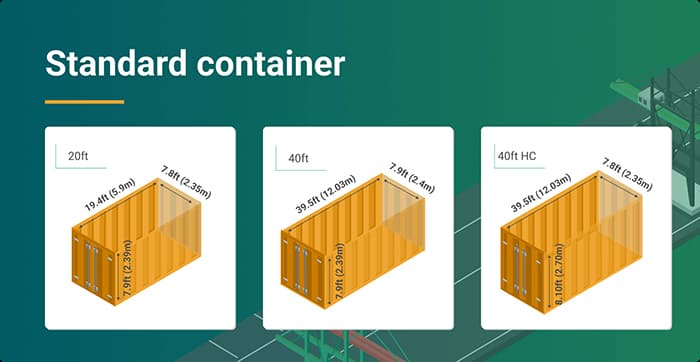
Before calculating the number of cartons, check the specifications of the container you plan to use. The table below provides the container data used as a reference in the original loading calculation.
| Size | 20ft | 40ft | 40ft HC |
|---|---|---|---|
| Internal length | 5.9m / 19.4ft | 12.03m / 39.5ft | 12.03m / 39.5ft |
| Internal width | 2.35m / 7.8ft | 2.4m / 7.9ft | 2.35m / 7.8ft |
| Height | 2.39m / 7.9ft | 2.39m / 7.9ft | 2.70m / 8.10ft |
| Cubic capacity | 1,172 cu ft / 33.2 cu m | 2,389 cu ft / 67.7 cu m | 2,694.5 cu ft / 76.3 cu m |
| Payload capacity | 55,126.9 lbs / 25,000kg | 61,200 lbs / 27,600kg | 63,052 lbs / 28,000kg |
| Tare weight | 5,071.5 lbs / 2,300 kg | 8,268.8 lbs /3,750 kg | 8,598 lbs / 3,900 kg |
Container dimensions, tare weight, cubic capacity, and payload can vary by equipment and shipping line. Check the specifications of the actual container before confirming the final loading plan.
For a detailed comparison of standard container sizes, see our 20ft, 40ft and 40HC container guide.
How We Calculated 598 Cartons in a 40HQ
For this shipment, each carton measured:
50 × 60 × 40 cm
and weighed:
15 kg per carton
We used the selected Maersk 40HQ specifications to check how the cartons could fit inside the container.
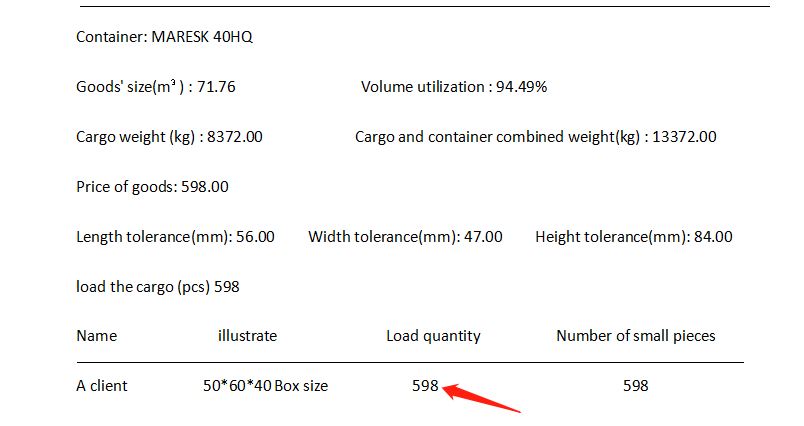
The loading calculation resulted in:
598 Cartons in One 40HQ
This result applies to this specific carton size, weight, container specification, and loading arrangement.
It does not mean every 40HQ can hold exactly 598 cartons of this size. Different internal dimensions or loading conditions can change the final quantity.
Why CBM Alone Is Not Enough
CBM gives you the total volume of your cargo, so it provides a useful starting point for a container loading calculation.
However, simply dividing the container’s cubic capacity by the CBM of one carton does not always give you the actual number of cartons that will fit.
The reason is simple: cartons must physically fit inside the container.
For example, carton dimensions may not divide evenly across the container’s length, width, and height. This can leave empty gaps even when the total cargo CBM appears to fit.
Carton orientation can also affect the result. Rotating suitable cartons may allow you to use the available space more efficiently.
Weight creates another limit. Heavy cargo may reach the container’s permitted payload before it fills all the available space.
If you need to calculate the volume of your cargo first, see our CBM calculation guide.
What Changes the Final Carton Quantity?
Four main factors can change how many cartons fit in a shipping container.
1. Carton Dimensions
The length, width, and height of each carton determine how many boxes fit across each row and layer.
Even a small change in carton size can change the loading pattern and final quantity.
2. Carton Orientation
Suitable cartons may fit in more than one direction.
Testing different orientations can sometimes reduce unused gaps and increase the number of cartons that fit. The cargo must still allow safe handling and stacking.
3. Cargo Weight
More available space does not always mean you can load more cartons.
For dense or heavy cargo, the shipment may reach the container’s permitted payload before it uses all the available volume.
4. Stacking Requirements
Identical, stackable cartons usually make it easier to use the available container space efficiently.
Fragile, irregular, or non-stackable cargo may require additional space or securing materials. This can reduce the final loading quantity.
What If Your Cartons Have Different Sizes?
The 598-carton example uses cartons with the same dimensions, which makes the loading pattern easier to calculate.
Mixed carton sizes require a different approach.
You need to consider how the different boxes fit together rather than calculating each carton size independently. Some combinations may use empty spaces effectively, while others can leave more unusable gaps.
For mixed cargo, provide the dimensions, weight, and quantity of each carton size before calculating the final container load.
If you plan to load the cartons on pallets, the calculation also needs to account for the pallet dimensions and loaded height. See our container pallet capacity guide for palletized shipments.
How to Prepare for a Container Loading Calculation
Before calculating your container load, prepare the following information:
- Carton dimensions — length × width × height
- Gross weight per carton
- Total number of cartons
- Number of different carton sizes
- Stacking restrictions, if any
- Pallet dimensions and loaded height, if palletized
You should also confirm whether the cartons can load in different orientations.
With this information, you can compare the cargo against the container’s internal dimensions and payload to create a more realistic loading plan.
Need Help Calculating Your Container Load?
Not sure how many cartons will fit in your container? Send ASLG your carton dimensions, weight per carton, quantity, origin, and destination. We can review the shipment details and help determine a suitable container for your cargo.
Container Loading FAQs
1. How do I calculate how many cartons fit in a container?
Start with the carton dimensions, weight, quantity, and container size.
Check how many cartons fit across the container’s length, width, and height. Then check the total cargo weight against the container’s permitted payload.
If the cartons allow different orientations, compare several loading arrangements to find a more efficient option.
2. Can I calculate the number of cartons using CBM alone?
CBM provides an estimate, but it does not show exactly how the cartons will fit inside the container.
Carton dimensions can create unused gaps. Weight limits, stacking restrictions, and carton orientation can also change the final quantity.
3. How many cartons fit in a 40ft container?
There is no fixed number.
The answer depends on the carton size, weight, container specifications, and loading arrangement.
For example, our loading calculation for cartons measuring 50 × 60 × 40 cm and weighing 15 kg each resulted in 598 cartons in the selected 40HQ.
4. Can rotating cartons increase container capacity?
Sometimes. A different carton orientation can reduce unused gaps and improve space utilization.
Whether this works depends on the carton dimensions and whether the cargo can be safely loaded and stacked in different directions.