
A flat rack container carries cargo that cannot fit inside a standard enclosed shipping container. Its open sides and roof enable shippers to load oversized machinery, vehicles, and industrial equipment that may exceed the container’s standard dimensions.
Flat racks come in 20ft and 40ft sizes, but choosing one requires more than checking cargo length and weight. Loading access, weight distribution, and carrier approval also matter.
Today’s article explains how flat rack shipping containers work and what to prepare when shipping oversized cargo from China.
What Is a Flat Rack Container?
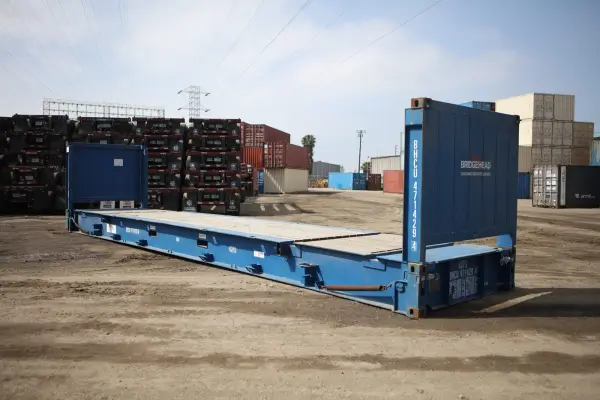
A flat rack container features a reinforced floor and end walls, with open sides and no roof. Depending on the design, it has either fixed or collapsible end walls.
Its open structure allows cranes and other lifting equipment to load cargo from above or the sides. Securing points along the container help keep cargo stable during transport.
Flat racks are special-purpose shipping containers. Explore our Guide to Shipping Container Types to learn about other container options.
Common Uses for Flat Rack Containers
Flat racks suit cargo that is too wide, too tall, or difficult to load into a standard container.
Typical examples include:
- Industrial machinery: Large production equipment and factory machinery
- Construction equipment: Excavators and other heavy equipment
- Vehicles: Oversized trucks and specialized vehicles
- Industrial components: Large steel structures, pipes, and equipment frames
- Cable reels: Heavy reels that require specialized lifting and securing
Not every heavy shipment needs a flat rack. If the cargo fits safely inside a standard container and stays within its permitted weight limits, conventional equipment may be more practical.
20ft vs. 40ft Flat Rack Containers
| Feature | 20ft Flat Rack | 40ft Flat Rack |
|---|---|---|
| Nominal length | 20 ft (6.06 m) | 40 ft (12.19 m) |
| Nominal width | 8 ft (2.44 m) | 8 ft (2.44 m) |
| Typical use | Shorter, heavy cargo | Longer machinery and structures |
| Loading access | Open sides and top | Open sides and top |
These are nominal external dimensions, not guaranteed usable loading dimensions. Actual deck length, end-wall clearance, and payload capacity depend on the specific container.
Check the equipment specifications before confirming a loading plan.
For cargo that requires a completely open loading platform, explore our Platform Container Guide.
Loading and Securing Flat Rack Cargo
Flat rack containers have no side walls or roof, so proper loading and securing are essential for safe transport.
Weight Distribution
Place heavy machinery on suitable timber supports or load-spreading materials to distribute its weight across the container floor. Check the cargo’s center of gravity and concentrated loads before loading. Do not rely on the container’s total payload rating alone.
Cargo Securing
Use chains, straps, blocking, or bracing to keep the cargo from moving during transport. Choose securing methods based on the cargo’s weight, shape, and available lashing points.
Protect vulnerable surfaces and ask the loading team to check the securing arrangement before the container leaves the factory or loading site.
Out-of-Gauge Cargo
If your cargo extends beyond the flat rack’s width or height limits, the shipping line may classify it as out-of-gauge (OOG) cargo.
Provide the packed dimensions, gross weight, and cargo drawings before booking. Your freight forwarder can then check carrier acceptance, available vessel space, and any additional handling requirements.
What to Prepare Before Shipping from China
Before requesting a flat rack shipping quote, ask your Chinese supplier for:
- Cargo dimensions and weight: Include packaging and supports.
- Photos or drawings: Show the cargo’s shape and lifting points.
- Loading details: Confirm any special lifting or handling needs.
- Shipping locations: Provide the pickup address in China and the destination port.
Your freight forwarder can use these details to check equipment availability, carrier acceptance, and shipping costs.
Final Thoughts
Shipping oversized cargo on a flat rack starts with accurate cargo details and a suitable loading plan. ASLG helps ship heavy machinery and oversized equipment from China by reviewing shipment requirements and checking available flat rack options with carriers.