
A platform container has a reinforced floor but no side walls, end walls, or roof. Its open structure provides loading access from the sides, ends, and top. Platform containers suit oversized, heavy, and irregular cargo that cannot fit inside a standard shipping container.
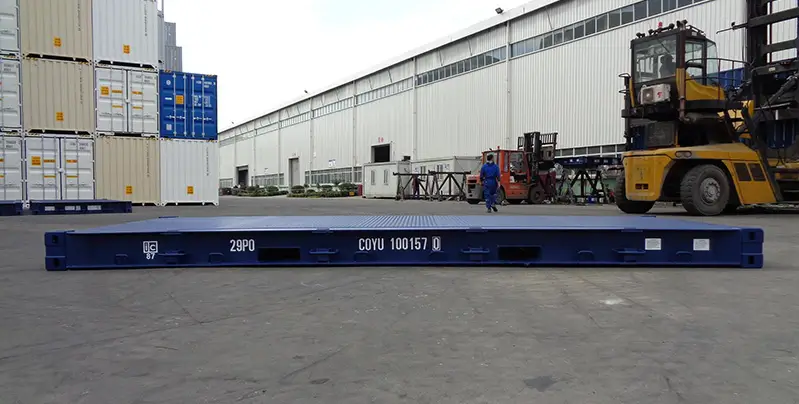
The following specifications provide a general reference for common 20ft and 40ft platform shipping containers.
| Specification | 20ft Platform Container | 40ft Platform Container |
|---|---|---|
| Tare Weight | 2,740 kg | 5,700 kg |
| Payload Capacity | 31,260 kg | 39,300 kg |
| Length | 6.06 m | 12.19 m |
| Width | 2.44 m | 2.44 m |
Note: These are representative specifications rather than fixed limits. Actual dimensions and payload capacity can vary by container. Confirm the equipment specifications and permitted cargo weight before booking.
This equipment suits large, heavy, or irregular cargo that cannot fit inside a standard shipping container. Common applications include:
Large machinery and production equipment with dimensions or weight that make standard container loading unsuitable.
Large equipment and components used for manufacturing and industrial projects.
Heavy or oversized equipment that requires open loading access.
Irregular or heavy cargo that needs a shipment-specific loading, securing, and transportation plan.
Cargo suitability depends on more than overall dimensions. Weight distribution, lifting requirements, securing points, route, and carrier acceptance can also affect the shipping plan.
Platform and flat rack containers both handle oversized or irregular cargo, but their structures and loading options differ.
| Feature | Platform Container | Flat Rack Container |
|---|---|---|
| Loading Access | Sides, ends, and top | Sides and top |
| Typical Cargo | Heavy, oversized, and irregular cargo | Machinery, vehicles, and OOG cargo |
| Structure | Open platform only | Platform with end structures |
The main difference is the end structure. A platform has no end walls, which provides loading access from the sides, ends, and top. A flat rack retains fixed or collapsible end structures.
The right option depends on cargo dimensions, weight, loading method, securing requirements, route, and carrier acceptance. For other equipment types, see our container shipping guide.
Check your cargo specifications instead of relying only on the nominal 20ft or 40ft container size.
Cargo Dimensions
Measure the final packed length, width, and height.
Gross Weight
Confirm the total cargo weight and compare it with the payload limit of the actual platform container.
Weight Distribution
Check how the cargo weight will spread across the platform, especially for heavy or concentrated loads.
Loading & Securing
Plan how to lift, position, and secure the cargo for transport.
Carrier Acceptance
Provide the cargo dimensions, weight, route, and loading requirements for carrier review before booking.
These checks are especially important for oversized and project cargo, which may need a cargo-specific loading and transport plan.
Platform containers commonly come in 20ft and 40ft sizes. Representative lengths are approximately 6.06 m for a 20ft platform and 12.19 m for a 40ft platform. Both have a representative width of approximately 2.44 m. Actual dimensions and specifications can vary by manufacturer, equipment owner, and individual unit. Always check actual equipment specifications before loading.
Representative payload capacities are approximately 31,260 kg for a 20ft platform and 39,300 kg for a 40ft platform. These figures are reference values, not universal limits. Check the payload rating of the actual equipment before loading.
A platform container has no side walls, end walls, or roof. A flat rack also has an open top and sides, but it has fixed or collapsible end structures. This gives a platform container open loading access from all directions. The right option depends on the cargo dimensions, weight, loading method, securing requirements, route, and carrier acceptance.
Airsupply handles oversized and project cargo based on the shipment dimensions, weight, route, and loading requirements.
99% Punctual Delivery
Track Everything Effortlessly
Direct Agent Price
All Shipping Modes; Every Cargo Type