
The Commerce Control List (CCL) is a U.S. export control list maintained by the Bureau of Industry and Security (BIS) under the Export Administration Regulations (EAR). It identifies certain goods, software, and technology that may require government authorization for export, reexport, or transfer.
For international shippers, the CCL matters because a shipment can face restrictions even when the goods are moving between two countries outside the United States.
Not every product is subject to the CCL, and not every listed item requires an export license.
The first question is whether the goods are subject to the EAR. If they are, their classification helps determine what restrictions may apply.Each CCL entry uses an Export Control Classification Number (ECCN). This five-character code identifies controlled items according to their technical characteristics.
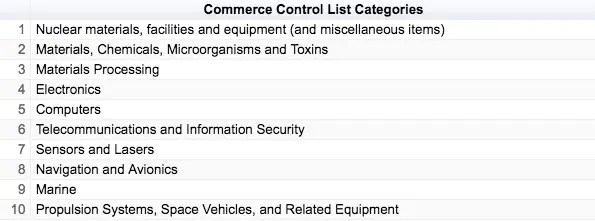
The CCL is organized into ten categories, each divided into five product groups covering equipment, materials, software, technology, and related items.
For the official classification reference, consult the BIS Commerce Control List.
Consider a Chinese distributor shipping U.S.-origin industrial equipment to a customer in another country.
Although the shipment departs from China, the equipment may remain subject to U.S. export controls. Before arranging transportation, the responsible parties need to establish its classification, destination, end user, and intended use.
If authorization is required, the shipment should not proceed until the necessary approval is obtained.
For a freight forwarder, incomplete classification information or unresolved licensing requirements can affect booking acceptance, documentation, and departure schedules.
The same principle can apply to certain foreign-made products that fall within the EAR’s jurisdiction.
| Term | What It Means |
|---|---|
| CCL | The U.S. list identifying specific controlled goods, software, and technology |
| ECCN | The classification code assigned to an item listed on the CCL |
| EAR99 | A designation for items subject to the EAR but not specifically classified under a CCL entry |
EAR99 does not automatically mean unrestricted shipping. Licensing requirements can still apply because of the destination, end user, or intended use.
An ECCN is also different from an HS code. ECCNs support export control decisions, while HS codes are used for customs classification and tariff purposes.
For classification details, see our ECCN guide.
When goods may be subject to U.S. export controls, the exporter or other responsible transaction party should establish:
- The product’s ECCN or EAR99 classification, where applicable
- Whether the shipment requires an export or reexport license
- The final destination, consignee, end user, and intended use
- Any authorization or supporting documentation required before dispatch
The CCL is not a freight charge or shipping permit. It is a regulatory classification reference. Any licensing costs, documentation requirements, or shipment delays depend on the specific transaction.
Correct classification does not replace customs declarations, carrier acceptance, or other transport requirements.
Export-controlled shipments require accurate documentation and confirmation of applicable licensing requirements before dispatch.
ASLG coordinates international freight from China, including cargo handling and shipping arrangements for shipments with specific documentation and transport requirements.Explore our supply chain solutions to learn more about international freight coordination.
1. Does the CCL apply to shipments from China?
Yes, in certain cases. U.S.-origin goods and some foreign-made products may be subject to the Export Administration Regulations (EAR), even when shipped from China to another country.
2. Does every CCL-listed product require an export license?
No. License requirements depend on the item’s ECCN, destination, end user, intended use, and applicable restrictions.
3. Can a freight forwarder determine an ECCN?
The exporter or other responsible party must ensure the product is correctly classified. Freight forwarders may assist with documentation, but they do not automatically assume responsibility for export control classification.